
Add Friction to Things That Matter
Why an effective dose of friction in some areas of life can lead to better work and experiences.

We've been running a collective race to remove or at least reduce friction from every corner of our lives for decades.
Note-taking apps arrived on our phones years ago to reduce friction in getting our thoughts recorded without having to pull out a pocket notebook.
AI is working to reduce friction at every touchpoint, whether it's searching the Web, reading, writing or even building software.
In e-commerce, 1-Tap Checkouts aim to reduce any friction between seeing an item and having it delivered to our doorsteps.
While I agree that minimising friction in some areas is necessary and productive, I'd argue we need to reintroduce friction in areas of our lives that matter.
We'll talk about that more in this post, but before that, let's start with:
Some real-world examples of effective friction
A few days ago, I was reading about Mason Currey's “inefficient” research process that has helped him write books and have a fruitful writing career.
What stood out was that even in the age of tools that make research a breeze, Mason has deliberately kept his process arduous.
Instead of having Claude or Gemini working autonomously, preparing drafts and connecting ideas, Mason does the entire process from collecting notes and highlights from books, writing commentary and fleshing out tangential ideas by hand.
And Mason's not alone here.
Ryan Holiday has written countless books using his laborious notecard method for years and still does.
But why? Why make a process difficult when we can make it frictionless?
Because the friction is the point.
When Mason or Ryan takes notes by hand and makes multiple passes, their minds see unexplored patterns, make connections and ultimately help them distil pages of information into a helpful theory or lesson for their books.
Without this intentional friction, the human mind only gets to process surface-level information, which isn't exactly the fertile ground for good ideas.
In all the years I've been writing online, I've noticed this too.
But the greatest benefit I've reaped with self-introduced friction is:
Adding friction to my personal finance
When I first started tracking my daily expenses, I opted for an app that read incoming transaction messages on my phone and automatically tracked those expenses.
It was frictionless and seemed like a good idea.
But after a while, I noticed that I had forgotten the app even existed.
It was on my phone, quietly doing its job, but since I was out of the loop, I never bothered to check the app for any spending reports, and it's safe to say that tracking this way had zero impact on how I spent my money.
Soon after that, I uninstalled the app and moved on to blowing away my paycheque like business as usual.
Then, about a year later, my wife suggested I use this app called Wallet to manually track my expenses and get a better idea of how I'm spending my money.
It seemed like a chore then, but after religiously following this habit for over 8 years, I can say it is one of the best habits I have developed in my life.
What changed? The added friction.
Logging each expense by hand made me conscious of my spending, which helped me spend more wisely the next time. It was a few minutes of work every day, but it reshaped my financial life.
But after tracking this way for 8 years, I realised, on many occasions, that while this level of friction worked, I could grease the wheels a bit.
So, when I started building my own personal finance app, Ducat, my goal was not to remove this habit of manually tracking expenses, but to make it a bit easier than filling out a form ten times a day.
I still log every expense or income by hand every day, but instead of clicking around buttons and jumping through form fields, I describe what I spent money on, and Ducat adds the expense for me:

I'm still in the loop, conscious of what I spend every day.
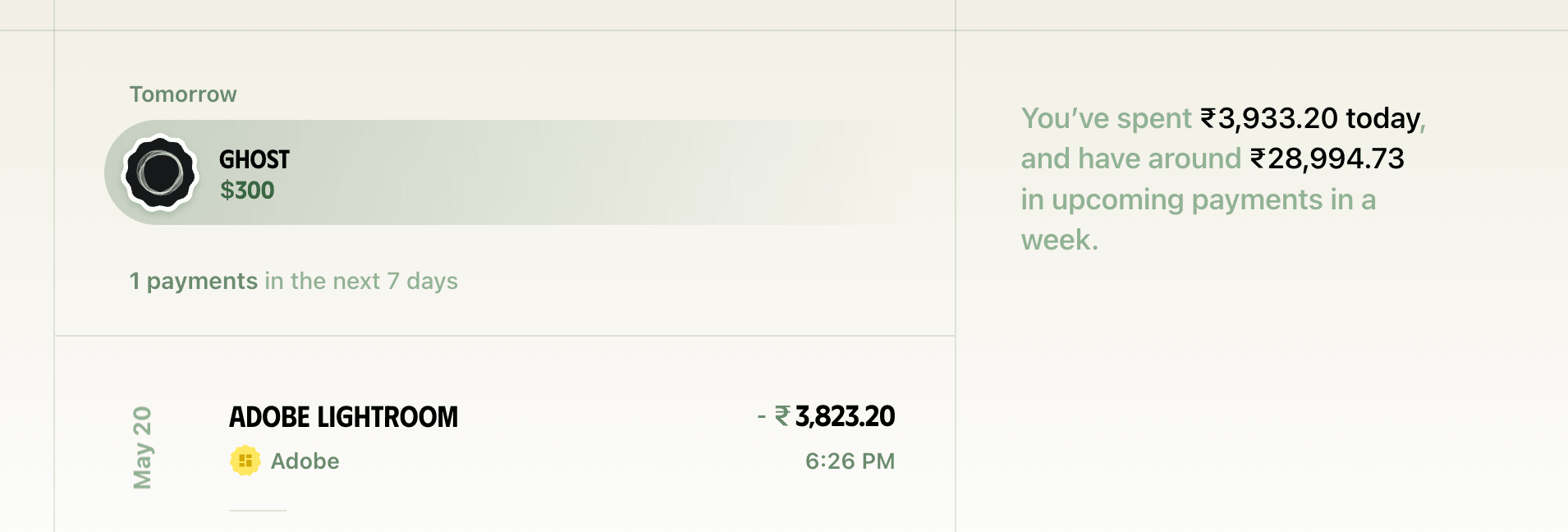
A side-benefit here is that every time I open the app to add an expense, I can see how I'm doing with money that day, which helps me understand if I'm overindulging and correct further spending accordingly:
All made possible by introducing the right amount of friction in an area of life I genuinely want to thrive.
But that begs a question:
Are frictionless workflows bad?
Short answer, no.
There are many areas where I enjoy having as little friction as possible. For example, playing music.
Instead of having to hunt down a cassette, plug it into a Walkman like in the early 2000s, tapping a song on my phone is a far better experience.
It's about adding friction where it can help.
While I can ask Gemini to plan an upcoming trip for me and have a good enough travel itinerary ready in a few clicks, I prefer doing the entire planning myself.
The friction here helps me be more intentional about the places I actually want to go, not what the trends suggest, and have a trip I'll remember for decades.
Your mileage may vary. Find the right level of friction for yourself in areas that matter to you.
And if you're looking to consciously manage your personal finance, try Ducat.